Top Startups to Watch in 2026: The Mid-Year Check
Olivia · May 28, 2026 · 12 min read
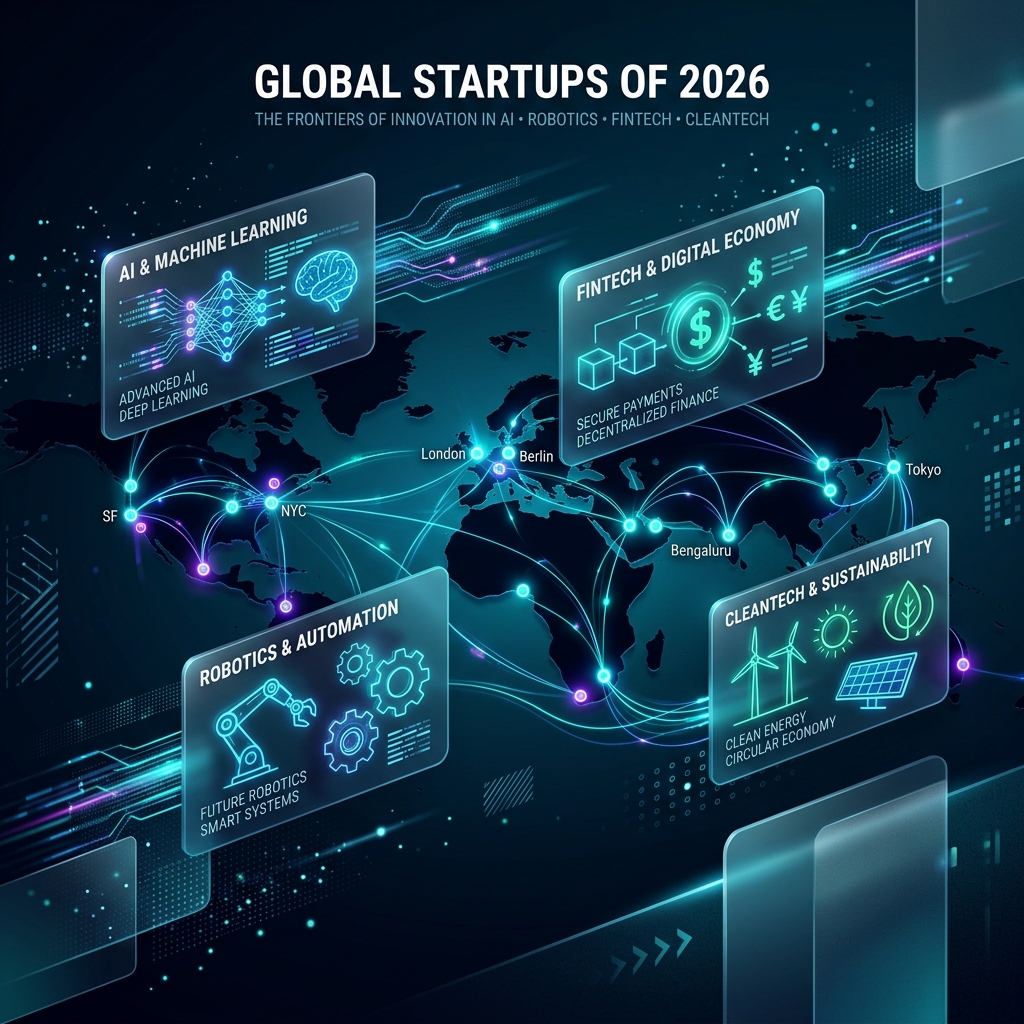
Most "top startups" lists arrive in January, full of predictions and momentum narratives. By June, half the picks have pivoted, a few have quietly died, and the genuinely interesting companies are ones nobody had on their list at all.
This is the mid-year version. No predictions — just eleven companies that have done something worth noticing in the first half of 2026. Some are well-funded and widely covered. Others are building in markets that the major startup publications rarely look at. Together, they paint a more honest picture of where startup energy is actually flowing right now than any single-geography list can.
At a glance
| Startup | HQ | Sector | Raised | Valuation |
|---|---|---|---|---|
| Lovable | Sweden | AI / Dev tools | $653M | $6.6B |
| Mistral AI | France | AI / LLMs | $3B+ | $13.7B |
| Apptronik | US (Austin) | Robotics | ~$1B | $5.5B |
| Adaptive Security | US (New York) | Cybersecurity | $81M | — |
| Omnea | UK (London) | Procurement / AI | $50M | — |
| Hadaa | US | AI / Proptech | Bootstrapped | — |
| Yakeey | Morocco | Proptech | $15M | — |
| Gigmile | Nigeria | Mobility / Fintech | $21M | — |
| NjiaPay | South Africa | Fintech | $3.1M | — |
| Woliz | Morocco | Retail-tech | $2.2M | — |
| Rivan | UK (London) | Cleantech | $13M | — |
Lovable — The fastest-growing software company in history, and it's Swedish
Stockholm · AI / Dev tools · Series B · Founded 2024
Lovable hit $100 million in annual recurring revenue faster than OpenAI, Cursor, Wiz or any other software company on record. Then it doubled that in four months. By February 2026, Sacra estimated the company was running at $400 million ARR with 8 million users.
The product is deceptively simple: type what you want your app to do, and Lovable builds it. Not a wireframe — a working application with a backend, authentication and deployment. The "vibe coding" movement that exploded in late 2025 found its commercial centre of gravity here, and the funding followed. A $330 million Series B in December 2025, led by CapitalG (Alphabet's growth fund) and Menlo Ventures, valued the company at $6.6 billion. Nvidia, Salesforce, Databricks and Atlassian's venture arms all participated.
What makes Lovable interesting at the mid-year mark isn't the revenue number — it's the question of durability. Can a tool that lets anyone build software maintain its growth as the novelty fades and the competitive field (Bolt, Replit, Cursor) intensifies? CEO Anton Osika's decision to stay in Stockholm rather than relocate to Silicon Valley is a bet that the answer lies in product depth, not proximity to Sand Hill Road.
Mistral AI — Europe's answer to OpenAI is targeting $1 billion in revenue
Paris · AI / LLMs · Series C · Founded 2023
Two years old and already valued at $13.7 billion, Mistral AI is the clearest example of European technological sovereignty in action. The company has raised over $3 billion — including an $830 million debt round in March 2026 to purchase 13,800 Nvidia chips for a new data center near Paris — and is targeting $1 billion in annual revenue by the end of this year.
Where OpenAI and Anthropic optimise for consumer and enterprise breadth, Mistral has carved a different lane: open-weight models, on-premises deployment options, and deep compliance with European regulatory frameworks. For enterprises that need AI but can't send data to US servers — banks, government agencies, defence contractors — Mistral is the default choice. The company now has roughly 1,000 employees, 450,000 customers, and Le Chat (its consumer product) hit 1 million downloads within 14 days of launch.
The VivaTech Top 100 Rising European Startups list called technological sovereignty the defining thread of its 2026 ranking. Mistral is the thread.
Apptronik — $1 billion to build the robots that will work alongside you
Austin, Texas · Robotics · Series A · Founded 2016
The humanoid robot race has a frontrunner that isn't Tesla. Apptronik closed a $520 million Series A extension in February 2026, bringing its total Series A to $935 million and overall funding to nearly $1 billion. The round valued the company at $5.5 billion. Investors include Google, Mercedes-Benz, John Deere, AT&T Ventures and the Qatar Investment Authority.
Apptronik's Apollo robot is already deployed in factories and warehouses with Mercedes-Benz, GXO Logistics and Jabil — not as a demo, but in paid operational pilots. The robot handles lifting, sorting and transporting components alongside human workers. A Google DeepMind partnership powers the next generation of Apollo's intelligence through Gemini Robotics.
The significance: robotics startups have been raising money for years, but Apptronik is the first to combine nearly $1 billion in funding with real commercial deployments at marquee customers. The gap between "impressive demo" and "robot that shows up to work" is where most humanoid companies die. Apptronik appears to be crossing it.
Adaptive Security — Protecting companies from AI-powered attacks
New York · Cybersecurity · Series B · Founded 2024
The same AI capabilities that let Lovable build apps from text prompts also let attackers build phishing campaigns, deepfake voice calls and social engineering attacks at unprecedented scale. Adaptive Security exists because the cybersecurity industry hasn't caught up.
The company raised an $81 million Series B in 2025 from Andreessen Horowitz, OpenAI's fund, Nvidia and Bain Capital Ventures — a signal that the AI companies themselves recognise the threat their tools create. Founded by repeat entrepreneurs who previously built Attentive ($7 billion valuation) and TapCommerce (acquired by Twitter), Adaptive Security already has 100–200 employees and is scaling fast.
This is a category that will only grow as generative AI makes attacks cheaper and harder to detect. Adaptive Security's bet is that defence needs to be AI-native too.
Omnea — AI procurement, quietly becoming essential
London · Procurement / AI · Series B · Founded 2022
Procurement is one of those functions that every company does and almost none do well. Omnea builds an AI-first platform that orchestrates the entire source-to-pay workflow — from approving a new vendor to managing renewals and spend. Backed by Accel, Khosla Ventures and Insight Partners ($50 million Series B in 2025), the company has grown revenue fivefold and tripled headcount since 2024.
Startups.co.uk named Omnea the number one UK startup for 2026. That recognition reflects a broader pattern: AI is increasingly winning not by replacing jobs but by automating the tedious processes that sit between them. Procurement, compliance, reconciliation — the unsexy middle-office functions are where AI creates the most measurable ROI.
Hadaa — 60,000 users, 130 countries, zero venture capital
United States · AI / Proptech · Pre-seed · Founded 2025
Take a photo of your yard. Sixty seconds later, you're looking at a photorealistic 4K landscape design — construction-ready, botanically accurate for your exact climate zone, complete with a bill of quantities you can hand to a contractor.
That's Hadaa. The numbers don't look like a 2025-founded company: 60,000+ users across 130 countries, $14/month plans, and around $2,000 in monthly recurring revenue — with no venture capital behind it. The platform's Biological Engine cross-references your geolocation with USDA Hardiness Zone data, so every plant recommendation is climatically accurate for your soil, sun exposure and frost dates, with filters for pet safety, drought tolerance and HOA restrictions.
In a landscape dominated by companies raising hundreds of millions before finding product-market fit, Hadaa is a reminder that the other path still exists: build something useful, charge for it, grow organically. The question isn't whether the product works — 60,000 users answered that. The question is what happens when capital meets this kind of traction.
Yakeey — $15M to fix Morocco's broken real estate market
Morocco · Proptech · Series A · Founded 2023
Morocco's real estate market runs on handshakes, paper contracts and cash. Yakeey is building the digital infrastructure to replace all of it — property discovery, AI-powered valuation, brokerage and mortgage financing on a single platform.
In January 2026, Yakeey closed a $15 million Series A — the largest ever completed in Morocco. The round was led by the International Finance Corporation (IFC's first venture capital equity investment in the country), alongside Beltone Venture Capital, Enza Capital and CDG Invest. When the IFC writes a first-ever cheque into a market, it tends to signal something larger than one company's prospects: it's a thesis that real estate digitisation in North Africa is ready.
Yakeey doesn't appear on any of the major US or European "top startups" lists. Neither do any of the other North African companies on this list. That's a gap in coverage, not a gap in substance.
Gigmile — $21M and 10,000 vehicles financing West Africa's gig economy
Nigeria · Mobility / Fintech · Seed · Founded 2022
If you're a delivery rider in Lagos and you need a motorcycle to work, the formal financial system has nothing for you. No credit history, no collateral, no loan. Gigmile, founded by two former Jumia country managers, built the financing layer that didn't exist.
Their platform uses a lease-to-own model: gig workers finance motorcycles, tricycles and cars with daily repayments capped at a third of expected income. Over 10,000 vehicles deployed. 8,500 active riders. 1,500 who already own their vehicles outright. Operations in 13 cities across Nigeria and Ghana. Total funding sits at $21 million in debt and equity, with a seed round led by Enza Capital alongside Seedstars and Norrsken Africa Fund.
The closest US comparison is the asset-financing layer that companies like Fair built for the American car market — but applied to a segment that is orders of magnitude more underserved and growing faster.
NjiaPay — Payment orchestration, built in Africa, aimed everywhere
South Africa · Fintech · Seed · Founded 2024
Every merchant operating across multiple markets faces the same problem: too many payment providers, each with its own integration, dashboard and reconciliation file. NjiaPay — spun out of Talk360 and founded by Jonatan Allback (eight years at Adyen) — orchestrates all of them into a single layer.
The company raised a $2.1 million seed round in March 2026 led by Newion, a European B2B SaaS investor, and is live in South Africa, Nigeria and Kenya. Checkout conversions increased 25 percent for Talk360 after deploying the platform.
Payment orchestration is a well-funded category in Europe and the US — Primer, Spreedly and Gr4vy have raised hundreds of millions between them. NjiaPay is the first credible entrant building this layer for African and emerging-market merchants, where the fragmentation is worse and the need is greater.
Woliz — Digitising the neighbourhood shops that power Morocco's economy
Morocco · Retail-tech · Pre-seed · Founded 2024
Morocco's neighbourhood shops — locally called "hanouts" — are everywhere, employ millions, and run entirely offline. Woliz gives them digital ordering, automated sales tracking and a financial footprint that opens the door to formal credit for the first time.
The $2.2 million pre-seed round was led by Sanlam Maroc, the Moroccan arm of Africa's largest non-banking financial services group — their first startup investment in the country. When the largest insurer on a continent makes its first venture bet, the signal matters: digitised informal retail isn't a charity case, it's a business opportunity.
Rivan — Synthetic fuel from sunlight, designed to actually ship
London · Cleantech · Seed · Founded 2022
Climate tech has a credibility problem: too many decks, not enough plants. Rivan is building modular, vertically integrated synthetic fuel facilities powered by off-grid solar, designed to decarbonise heavy industry — shipping, aviation, steel — where electrification isn't an option.
The company raised a $13 million seed round in 2025 from Plural, 20VC and the founder of Stripe. The Stripe connection matters: Patrick Collison's Frontier programme has become a de facto quality filter for climate companies that are serious about deployment rather than research.
Rivan's approach — modular plants that can be replicated rather than one-off megaprojects — mirrors the playbook that made solar panels cheap. Build one, learn, shrink the cost, build hundreds. If it works, it's the kind of infrastructure that reshapes an industry. If it doesn't, it's another climate deck. The seed funding says enough people with good judgment think it's the former.
What this list tells you
The most obvious pattern: AI is no longer a sector. It's a layer. Lovable uses it to build apps. Adaptive Security uses it to stop attacks. Omnea uses it to manage procurement. Hadaa uses it to design gardens. Mistral builds the models everyone else runs on. Separating "AI startups" from "non-AI startups" in 2026 is like separating "internet startups" from "non-internet startups" in 2006 — a distinction that's about to stop making sense.
The less obvious pattern: the best startup lists are lying to you by omission. Every major "top startups 2026" ranking — Startup Savant, VivaTech, topstartups.io — covers the US and Europe exclusively. Zero African startups. Zero MENA startups. That's not because nothing is happening in those markets. Yakeey raised Morocco's largest-ever Series A. Gigmile has 10,000 vehicles on the road. NjiaPay's founder spent eight years at Adyen before building payment orchestration for the world's most fragmented markets. These companies don't show up on the lists because the lists don't look.
The infrastructure pattern connects everything. None of these eleven companies are building consumer apps or social networks. They're building plumbing — payment rails, procurement orchestration, vehicle financing, robot workers, fuel plants, design automation, AI models. Boring from a headline perspective, foundational from an economic one. The next generation of consumer products will be built on top of what these companies are building right now.
Looking for capital to fuel your own growth? Browse open funding programs.